• Skip to primary navigation
  • Skip to main content
Uphill Books

Uphill Books

Movement Matters

Uphill Books

Movement Matters

  • Home
  • About
    • Mission
    • Team
  • Books
    • Our Books
    • Audiobooks
    • Translations
  • Contact Us
    • Media
    • Authors
    • Submissions
    • Librarians
    • Distribution

admin

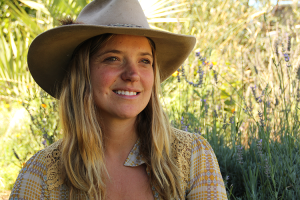
Introducing Doniga Markegard

May 29, 2017 ·

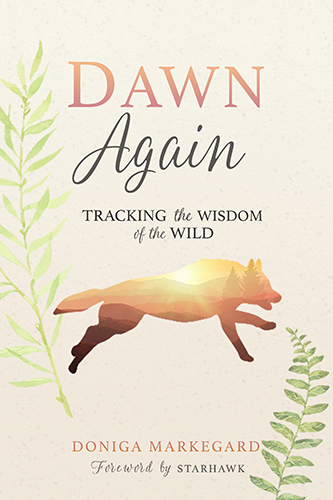
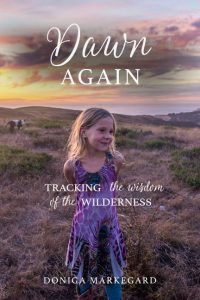
This fall we’ll publish Dawn Again: Tracking the Wisdom of the Wild, by Doniga Markegard. We’re excited about this book (Starhawk is writing the foreword!!), a memoir that traces Doniga’s life from the time she was a teenager seeking direction and meaning, through her time at the Wilderness Awareness School in the Pacific Northwest, from her studies with Lakota elder Gilbert Tatanka Mani, to tracking mountain lions along California’s rugged coast, to falling in love with a rancher named Erik and starting a life and a family with him. Doniga’s understanding of the natural world, and the lessons it holds for all of us make this memoir a must-read for anyone longing for a deeper connection with nature. When you order Dawn Again through our pre-sale, you get access to a thirty-minute long audio file called Tracking for Beginners, in which Doniga offers tips and advice so you can get started right now, no matter where you are. 

We had a chance to ask Doniga some questions about Dawn Again. Here’s our conversation:

When you think back to where you were in your life when you began learning to track, what kind of road might you have followed if tracking and wilderness studies had not presented itself as an option?

That is an interesting question. I discovered tracking when I was searching for meaning in my life and a direction where I could feel part of the solution to some of the destructive things I saw happening around me. As a child I would often ride my horse on logging roads and witness an entire hillside clearcut. When I began traveling the county and seeing crop dusters spraying chemicals on long rows of monocrops I became further disillusioned. I had grown up close to nature and the beauty of rivers and trees. It was not until I began tracking that I connected the pleasures I felt or fully understood that the life I experienced growing up was being threatened by over extraction of resources. I think if I had not discovered tracking I may have followed what the people around me were doing instead of following my heart. It is hard to say where I would have ended up because my life took so many turns, yet I was always led back to nature.

What do you think Gilbert Tatanka Mani saw in you that made him want to work with you?

Gilbert did not just mentor anyone who came along. Some people would visit searching for spirituality and he would remain silent. He had a way of knowing what stories and lessons to share at just the right moment. I think what he first saw in me was a passion for learning everything about nature and he admired that. At first he did not pay too much attention but taught me small things such as how to make prayer ties or a sacred song. When he would share something with me I would immediately take it on in my life and practice it daily. It was this dedication that he saw in me and led him to share more. When I would tell Gilbert what I learned and stories about my time in nature he would share more. This grew to a very deep spiritual relationship, one that I had not expected going in, yet emerged in the most natural way.

You kept extensive tracking journals that you were able to go back to in writing this memoir. What went through your mind as you pored over those?

I loved looking back at my old tracking journals. It was like peering back in time to the first discoveries of the stories that are all around us. The maps I drew immediately brought up vivid memories of the places I frequently tracked. I could almost smell the cottonwood buds and hear the rivers and feel the rocky sand beneath my feet.

What has tracking brought to your life?

Tracking has brought a deeper sense of my own connection to everything around me. It has also brought me a deeper connection to myself. When tracking an animal I put myself in the past, present and future in order to gain clues about the animal, what it was doing, where it was going, when it passed by and why the animal was moving the way it was moving. When I track I ask a lot of questions. These types of questions, who, what, when, where, why and how can be applied to anything in my life. Solving mysteries of tracking can convert to problem solving at my own ranch. Tracking also brought me a very keen sense of observation. While tracking I am constantly looking at the natural cycles around me to take in the bigger picture of the story. Now that I am practicing regenerative agriculture, that keen sense of observation has been key to making good decisions for our family and our land.

What did you learn about your own experiences in tracking, ranching, and raising a family by writing Dawn Again?

Writing Dawn Again provided me with a time to reflect. I think often times people do not take the time to do that in their lives and they may keep moving forward without learning the lessons from the past. Writing the book also gave me an opportunity to be thankful for the gifts I have been given. I felt so grateful for the lessons of nature, the mentors in my life and my family that have all shaped who I am and the outcome of what my life has become. Often when I was writing and thinking very hard about how to approach a chapter or a subject I would do research of things that were already written, but that did not give me the feeling that I was complete about my writing. What helped me to round out my stories of the past was when I walked outside and interacted with nature, or sat down and had a conversation about the subject with my husband, children or friends. One time I was writing a story about a coyote and I walked out my front door and a coyote was standing up on the ridge. When I was writing I was paying very close attention to everything around me, just like tracking I was looking into the past, present and future through all of my senses. What really came out when I was writing was the less tangible sense of instinct. I just got into a zone, like when I trail an animal. My fingers moved and not many thoughts went through my head as the words came on the screen.

See and hear more from Doniga Markegard here on the San Francisco Exploratorium website, where Doniga is part of a permanent exhibit called Listen.

will be published November 1, 2017. Our pre-sale is on now, through the summer. You can follow Doniga Markegard on Instagram to see nature through her eyes, and to glimpse some artifacts of her tracker past.

Come work with us!

May 26, 2017 ·

Spread the word: Propriometrics Press is seeking a marketing co-ordinator!
We’re looking for a US-based marketing whiz with at least 4 years’ experience in book marketing to work as our in-house marketing co-ordinator.
We’re a small but rapidly growing company and we’re in search of someone who’s excited about our message to create and execute complete marketing plans for our publishing programme.
This will include creating full marketing plans for each title, creating and placing ads, pitching media, booking events, running our social media platforms (Facebook, Instagram, Twitter), and more. You’ll work with our editorial, operations, and design teams, as well as our amazing authors.
We need someone with big-picture strategic capabilities as well as the ability to do the day-to-day work of implementing our plans.

• Work can be remote or in-office in Sequim, Washington. 20 hours a week: 8–12 PST Monday to Thursday, with four more hours when needed (occasionally weekends or evenings). As the company grows, these hours may increase.
• $30/hr

To apply: Please send us a cover letter and CV, as well as a sample full book marketing plan, either one you’ve created in the past, or for a book from our list. Send to [email protected]. Deadline is June 5, 2017.

Cover Story: Designing Dawn Again

May 16, 2017 ·


This fall, we’ll publish Dawn Again: Tracking the Wisdom of the Wild, by Doniga Markegard. It’s a riveting memoir of exploration and survival. As a young girl, Doniga Markegard was thrown from her horse and knocked unconscious. She remembers an out-of-body experience that revealed to her the great mystery at the heart of life. In Dawn Again, she writes of the journey that experience sparked.

At a wilderness immersion school, medicine people and wildlife trackers train her in indigenous ways. Her search for an authentic life takes her hitchhiking across the West and to Alaska, where she falls deeply in love with tracking wolves and the rigors of surviving in the wilderness.

 Doniga seeks a vision and discovers her purpose, only to find herself on a cattle ranch, falling in love and starting a family, and learning a new way to apply the deep, unshakeable lessons of the wild.

We’re really excited about this book and we knew it needed a really special cover. So we turned, as we do, to our incredibly talented designer, Zsofi Koller. She did not disappoint. We took the opportunity to chat with Zsofi about the cover for Dawn Again, and what went into making it.

How do you approach the design of a cover for a new book?

Book cover design is about making an intangible tangible. On one hand, there are endless options. ENDLESS. On the other hand, if you listen to what the book is about—and I mean, listen with ALL your senses—some ideas become clear tracks to follow. And I follow those tracks, and see what happens.

When I’m doing first cover design, the book itself might not be written fully yet, or I might not have access to the full manuscript. So I’ll often get a debrief from the editor or author about the WHAT of the book. Not just the what—also, the spirit and heart of it. And I’ll daydream about it, and I’ll go to the bookstore and roam around thinking about it, and I’ll look at approximately a billion things online to get ideas.

And eventually I start to pile together ideas from my mental toolbox, and often times visual cues from my teammates, and it starts to take shape. And then I run my first concepts by our team, and we take it from there.

You chose not to use a photograph for this cover. Why not?

Well, we did try that idea. Pretty cute, right? (We were still ironing out the subtitle at that point, too, it seems!)

But it wasn’t the right idea for this book. This book isn’t best expressed by a photo. There’s a side of introspection, of spiritual exploration, that is best captured by a slightly more evocative imagery. So the thought of a wolf that embodied a sunrise felt too perfect to not use.

 What were some of the particular challenges in designing this cover?

In total honesty, this cover didn’t feel like it had challenges. It came together pretty seamlessly. There were a lot of different iterations of sunrises and wolves though!

How do you know when you’ve landed on the right design?

When it makes someone on the team cry. And I can just feel it, too. When I come back and look at the design 24 hours later and still love it, I know it’s working. When I want to show it to my husband, it’s working. When I want to sweep everything into the garbage bin and keep working, it’s not right yet. And there’s really no short cut to the process. Sometimes it takes less time, or more time, but it’s always a process.

 What do you most like about this final design?

I love the colour palette. A lot of our covers tend to be quite bold, which I love as well, but I enjoy the softness of the greens, pinks, oranges, and cream in this cover. It certainly feels true to a glorious dawn. I’m also very fond of the fonts we landed upon. A good font for a book is a little gift that keeps giving. I’m so looking forward to the interior design—the pieces have been laid in play so nicely by the cover, it makes the whole design process flow smoothly.

Mother of all gardens

May 10, 2017 ·

My mother has always been a gardener. Together, she and my father turned our suburban corner lot into a glorious green place, where we grew most of the vegetables our family of six ate in the summer, where we composted our organic kitchen waste (long, long before composting was trendy, or even understood by our friends and neighbors), and where we kids spent summer evenings picking stones out of the soil, and summer mornings harvesting endless rows of beans, cucumbers, and tomatoes so my parents could pickle, can, and otherwise preserve them.

Years passed, and our yard went through many phases, growing and changing as our family did. The huge garden gave way to a swimming pool and my parents continued to grow a few tomatoes and other favorites in raised beds my dad made. After he died, those went fallow, and then gave way to grass.

But this year, my almost-seventy-year-old mother decided she’s ready to grow some tomatoes again. There’s a decently sunny patch just off the deck in the backyard, but it was terribly unkempt, filled with raspberry canes and spring onions that had gone rogue from other parts of the garden, and a rhizome-spreading visitor from next door.


Mom wanted three planting boxes, and a stone pathway she could use to get among them to do her work. So, on a recent visit in advance of Mother’s Day, my spouse knocked together three nice planters, and Mom and I got busy with shovels, rakes, and brute strength. We pulled out an old planter, dug out bags and bags of that invader from next door, harvested some spring onions and some nearby rhubarb, dug out and moved rocks that were in our way, and got the area ready to become a new garden.

This made for two day’s worth of bending, pulling, pushing, grasping, squatting, single leg squatting, reaching, and twisting, lots of barefoot-on-dirt time, and tons of fresh air. Not to mention the time spent hanging out with each other, working side by side, or resting on the deck, drinking water and congratulating ourselves on our hard work.

Mom wanted a path she could feel comfortable stepping down onto, and walking over, while she goes about her planting and weeding. Something that would provide both stability for her less-sure moments, and enough texture that she can continue to challenge her balance and give her bare feet some lumps and bumps to navigate.

My mom has just started reading Dynamic Aging, and while she doesn’t see herself climbing trees like Joan, Joyce, Shelah, and Lora, she is absolutely interested in aging well, maintaining the mobility she does have, and even gaining more if she can. She’s even getting back to her composting roots, albeit on a smaller scale than our garden’s earliest days.

I’ve been working to #stackmylife more consistently, and this project really lent itself to that philosophy: I moved more, and moved more of me, racked up some barefoot time, spent time with my mother, took care of a little patch of the Earth, enabled my mom to move more, and move more of her, and to divert some organic waste to her own backyard to feed the soil that will eventually feed her (and me, if I’m lucky!). Also, that’s Mother’s Day gift-giving done and dusted. A pretty efficient use of two mornings, I must say.

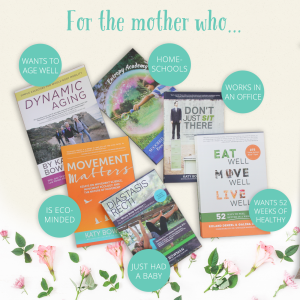
If you’re still looking for a gift for your mom, or for one you know, we’ve sorted some of our recent books into helpful piles for you! Find what you’re looking for at your favorite online or bricks and mortar book retailer, and Happy Mother’s Day to all who mark it!

 

Cover Story: Making the new Move Your DNA Expanded Edition cover

May 1, 2017 ·

It’s publication day for Move Your DNA, the Expanded Edition. It’s available now in paperback, audiobook, and for Kindle and e-readers. Congratulations to Katy Bowman on this new edition, which features a three-level movement program, an exercise glossary, and all-new photos. It also features a spiffy new cover, courtesy of our incredibly talented designer, Zsofi Koller. We took the opportunity to chat with Zsofi about the new cover, and what went into making it.

What was the original concept for the Move Your DNA cover? What range of things were you trying to convey?

We wanted to show a combination of both natural, everyday movement AND that our underlying body physiology plays an important role in the book, too. So the silhouette of the woman in a natural squat by a fire, juxtaposed with the bone cells and the DNA overlay felt like a good fit.

What went through your mind when you realized you’d get another crack at it, with the expanded edition?

“Hello old friend! Let’s brighten you up.”

How did you prioritize the changes you wanted to make—what was most important to capture on this updated cover?

Well the priority will always go to making the content as accessible as possible. So clarifying the “what” is behind it the new edition takes top billing.

 That orange is reminiscent of the cover for Movement Matters, also by Katy Bowman. To what degree do you take the covers of an author’s other books into consideration in each new design?

Katy and I both love the colour orange very, very much so when I was thinking of a “vibrantly updated cover” it just landed there. Orange is the colour of action, change, and is powerful and bold. It really speaks to me as an important colour for Katy’s work. Since I design most of Katy’s book covers I like to think of them matching in tone and spirit. I will absolutely take elements I like from the different books and intermingle them. The content of each new book makes them stand apart in new and different ways each time.

What’s your favorite part of this cover design?

Seriously, I have the best job ever because I get to visually represent ideas that are ground-breaking and help make people’s lives—and the planet—better. That’s a pretty sweet gig, no? I love every cover because it represents a new problem to be solved. For this cover it was: “How can we retain the concept of the original edition and make it feel new and fresh?” Solving that problem elegantly is what makes me excited.

And if you’re curious about what’s new with this expanded edition beyond the cover… here’s a little more about that:

  • « Go to Previous Page
  • Go to page 1
  • Interim pages omitted …
  • Go to page 4
  • Go to page 5
  • Go to page 6
  • Go to page 7
  • Go to page 8
  • Interim pages omitted …
  • Go to page 10
  • Go to Next Page »
Uphill Books

Uphill Books
Movement Matters

© Uphill Books 2025. all rights reserved.
Design by Lilt Creative.

contact us Uphill Books on instagram

© 2026 Uphill Books. all rights reserved.

Design by Lilt Creative.